How to write for people to read
I must confess that I am not good at writing.
In fact, I am so bad at writing that I had to research “How to write for people to read”.
Here are a few quotes I now read before I write:
“If you can’t explain it simply, you don’t understand it well enough.” — Einstein
“If I had twice the time, I’d have written half as many words.” — Blaise Pascal
“Use the smallest word that does the job.” — E.B. White
“Make every sentence say one thing well.” — Strunk & White
“Writing is music, not math.” — Truman Capote
“Good writing is clear thinking made visible.” — Bill Wheeler
“Clear writing is a sign of clear thinking.” — Peter Thiel
“If you can’t write your idea on the back of my business card, you don’t have a clear idea.” — David Ogilvy
“Judge a man by his questions rather than his answers.” — Voltaire
“To write well, express yourself like the common people, but think like a wise man.” — Aristotle
“If they can’t picture it, they won’t remember it.” — Claude Hopkins
“When you show your reader what you see, they will trust that you see more.” — Joan Didion
“Start with a strong truth, and the words will find their gravity.” — Charles Bukowski
“To convince others, you must first convince yourself.” — Aristotle
“The reader is not stupid; the reader is busy.” — William Zinsser
“What is written without effort is generally read without pleasure.” — Samuel Johnson
“Don’t write for everyone.” — Brian Clark
Reading 101:
You are competing for shorter attention spans.
You are competing against TikTok, Youtube, Meta and more.
Assume the reader is busy, tired, selfish and unintelligent.
The reader makes an immediate decision: They will not read if they believe the value gained from reading is less than the value of their time.
The reader will stop reading, when they decide that the value gained from finishing reading is less than the time-cost to finish reading.
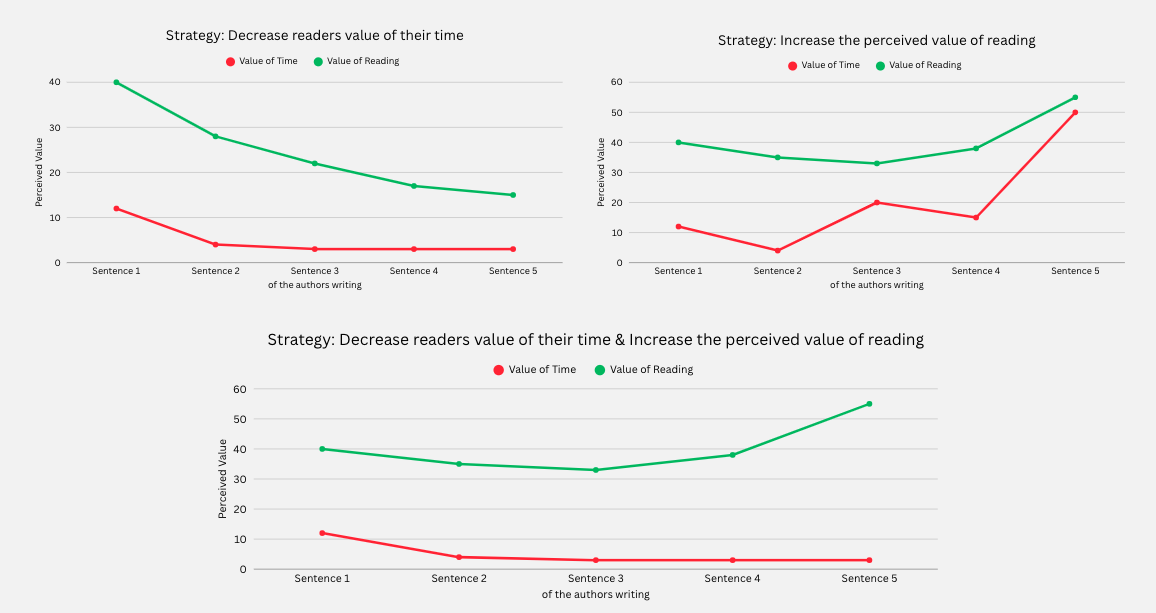
The 3 ways to keep a reader reading:
- Devalue their time (Top Left)
- Pros: pain is a better motivator than hope.
- Cons: resentment, lower self-worth, depression.
- Increase perceived value of reading (Top Right)
- Pros: easy to keep promising more value.
- Cons: failing to deliver promised value loses credibility.
- Devalue their time & Increase perceived value of reading (Bottom)
- Pros: largest value discrepancy.
- Cons: requires deep knowledge of the reader.
Paragraphs:
- Every paragraph must have one purpose: make the reader understand.
- People of low-intelligence should be pleased they can clearly understand.
- People of high-intelligence should be pleased they can read effortlessly, without having to interpret unnecessarily large words or decode hidden meanings.
- People not fluent in the language should be pleased they can clearly understand.
- Every paragraph should only make one point.
- Sentences in paragraphs should not be unnecessarily long.
This is how I write now:
- Brain Dump (what is on my mind which I must not forget)
- What is the purpose of writing this?
- What is the outcome of writing this?
- Who is reading this?
- Start with a strong truth, that you whole-heartedly believe.
- Write specifically for this reader.
- Rewrite the entire thing so that every sentence say one thing well. Do this by explaining things simply in the small few words. Thinking as a smart man, Expressing as a common man.